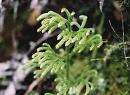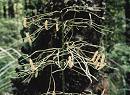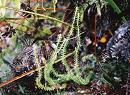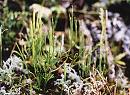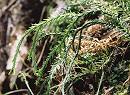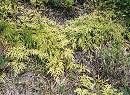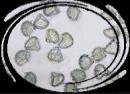
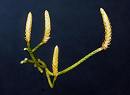
 The club mosses are small, creeping, terrestrial or epiphytic, vascular plants, which lack flowers and reproduce sexually by spores. The sporophyte consists of true roots, an aerial stem and scale-like leaves which are microphylls. These are small and spirally arranged on an elongated stem.
The spores are generally borne singly in the axils of specialised leaves (sporophylls), and these are often aggregated into cone-like strobili. It's these sporophylls that resemble clubs and give this group it's name.
New Zealand has around 10 species, some of which are common. They were the dominant plant group in the Carboniferous period, where they attained the size of trees, and were the main contributors to the coal deposits found today