Boletinellaceae
Common Names
Species Menu
Family Menu
Identification Guide
Fungi:> Basidiomycota:> Agaricomycetes:> Boletales:> Boletinellaceae:> Phaeogyroporus.
The Boletinellaceae are a small family of boletoid fungi characterised by poroid hymenophores, dry to slightly viscid caps, and often long, rooting or deeply inserted stipes. Spores are typically smooth, ellipsoid, and yellow‑brown in deposit. Fruitbodies are usually slender, sometimes with pale to brightly coloured pores, and lack the heavy reticulation seen in many true Boletus species.

Members are ectomycorrhizal, especially with Casuarinaceae and Nothofagaceae, and occur mainly in Australasia, South America, and parts of Asia. The family includes genera such as Boletinellus and Phlebopus, the latter containing some unusually large, robust boletes atypical for the group.
Genus: Phlebopus
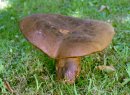
Phlebopus is a genus of large, robust boletes notable for their thick, fleshy caps, broad pores, and massive, often swollen stipes. Caps are typically dry, smooth to slightly tomentose, coloured brown, yellow-brown, or olive-brown. Pores are yellow to olive, usually large and angular, and may bruise slightly darker. Flesh is pale yellowish, firm, and does not blue. Spores are smooth, yellow-brown, and ellipsoid.

They often fruit as solitary giants, sometimes forming impressive clusters. Distinguished from other boletoid genera by their sheer size, thick context, and yellow-brown spore deposit.
Phlebopus marginatus Phlebopus aff. marginatus
 
The Hidden Forest   Forest Fungi