Geoglossaceae sp.
(orange bifurcate form)
Description:
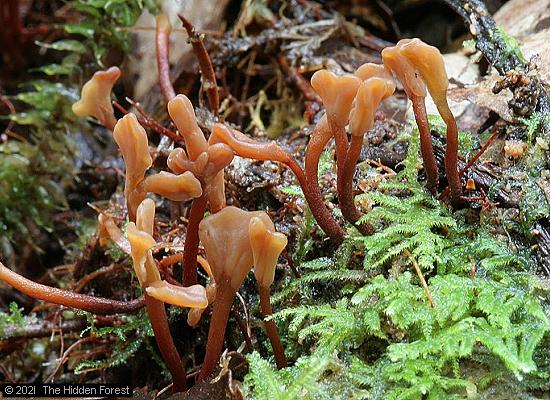
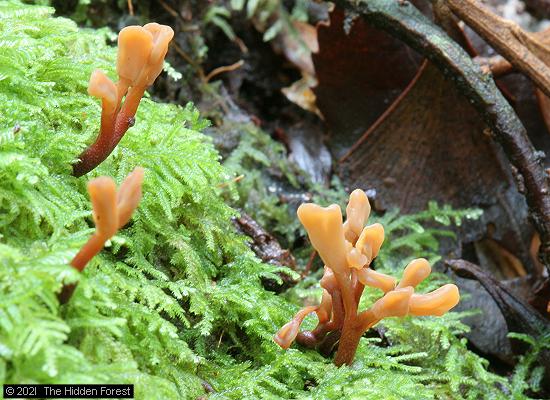
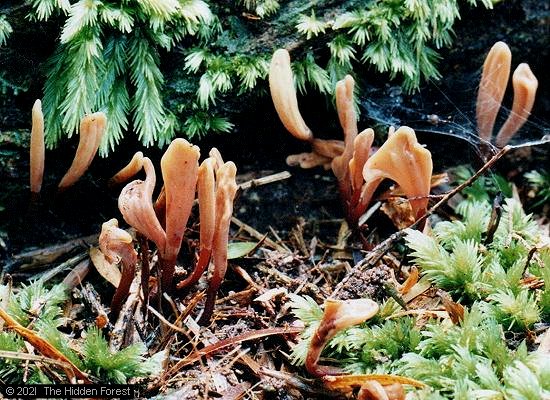
Bright orange earth‑tongue with a slender reddish stipe and an unusual bifurcate habit, where the stipe often splits to form two separate fertile heads. Found among moss in damp forest. A distinctive and possibly undescribed member of the Geoglossaceae.

Fruitbody:
Slender, upright, 15–35 mm tall. Fertile head orange to apricot, irregularly clavate, often lobed or flattened, sometimes appearing as two small heads on a shared stalk. Surface smooth, moist, semi‑translucent when fresh. Colour may deepen toward the tips.
Stipe: Reddish‑orange, smooth, delicate, semi‑translucent. A key feature is the bifurcation occurring within the stipe itself, producing two diverging fertile heads from a single base. This branching pattern is unusual for Geoglossaceae, but the overall architecture remains earth‑tongue‑like.
Flesh: Soft, fragile, pale orange; no distinctive odour.
Odour/taste: Nno distinctive odour.
Common name: None
Habitat: Lowland podocarp-broadleaf forest
Substrate: Growing among moss on damp, shaded forest floor.
Distribution: North Island
Season: Autumn to early winter
Biostatus: Endemic to New Zealand
Edible: No
Spore print: White
Macro images:
Microglossum olivaceum
Scale bar
Scale= 7 mm.
 
Microglossum olivaceum
Scale bar
Scale= 7 mm.
 
Microglossum olivaceum
Scale bar
Scale= 7 mm.
 
The Hidden Forest
Forest Fungi