Geastrum fimbriatum aff.
(sensu NZ)
Description:
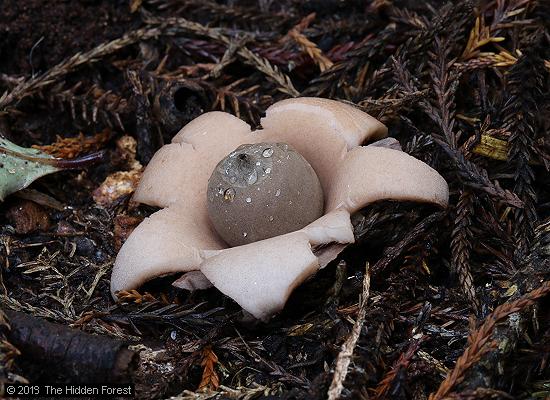
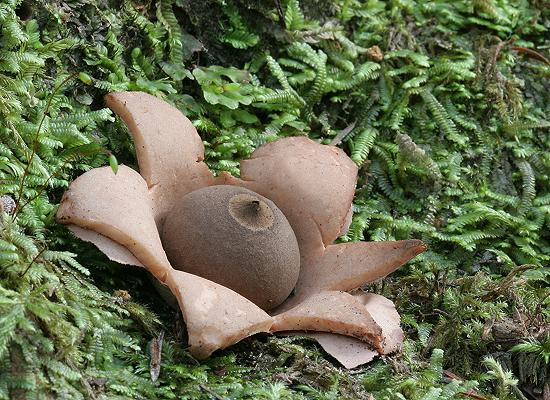
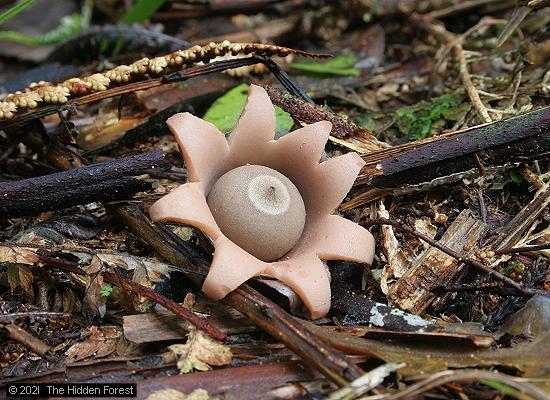
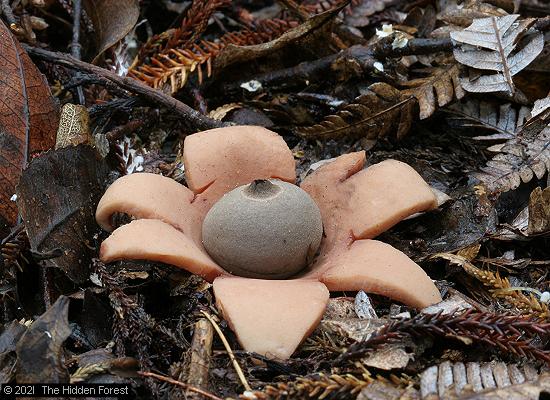
Pale earthstar with smooth spore sac and a thin papery inner layer beneath the rays; NZ lineage resembling G. fimbriatum but genetically distinct.

Basidiome (immature): Subglobose, 10-25 mm diam., pale buff to light brown. Outer peridium smooth to slightly powdery. Often partly buried in leaf litter or moss.
Basidiome (mature): When expanded, 3-6 cm across, with the exoperidium splitting into 6-10 rays.
Rays: Pale buff to light tan, often lighter than other NZ earthstars. Moderately broad, not sharply pointed. Smooth, not velvety and not cracking. Reflexed to spreading. A thin, papery inner layer (inner exoperidium) is often visible beneath the rays - a key diagnostic feature of this species group.
Spore sac: Smooth, evenly coloured grey‑brown. Globose, typically 10-18 mm diam. Apex with a simple, fibrillose peristome, not beaked. No collar or apophysis. Gleba white when young, becoming dark brown and powdery at maturity.

Common name: Earth stars
Habitat: Lowland podocarp-broadleaf forest
Substrate: Saprotrophic on soil, humus, moss, and leaf litter.
Distribution: New Zealand
Season: Autumn to early winter
Biostatus: Exotic
Edible: No
Spore print: Dark-brown
Macro images:
Geastrum saccatum
Scale bar
Scale= 6.6 mm.
 
Geastrum saccatum
Scale bar
Scale= 6.5 mm.
 
Geastrum saccatum
Scale bar
Scale= 6.5 mm.
 
Geastrum saccatum
Scale bar
Scale= 6.5 mm.
 
The Hidden Forest
Forest Fungi