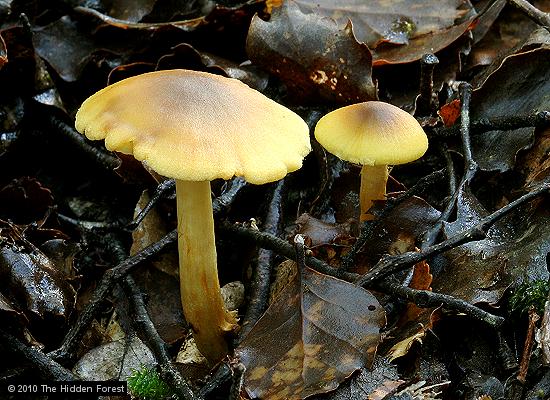
Cortinarius icterinoides
(E. Horak) G. Garnier 1991
Description:
A medium-sized golden-yellow Dermocybe-like cortinarius, recognised by its bright golden pileus with a brownish/sooty apex, golden lamellae without olive tones, slender fusoid stipe, and KOH reaction that turns orange-brown to red-brown to black.

Cap: Up to 50 mm diam.; hemispherical‑convex to umbonate‑campanulate with a conspicuous conical papilla. Colour golden yellow, with a distinct brownish or sooty tinge over the apex. No olive shades. Surface dry, slightly viscid only when moist, innately fibrillose to glabrous, scarcely hygrophanous. Margin rarely striate; no veil remnants.
Lamellae: 12-20 primary lamellae, with up to 7 tiers of lamellulae. Attachment emarginate, often subdecurrent with a short tooth. Up to 5 mm wide. Colour bright golden yellow (never olive), turning yellow‑rust brown in maturity. Edges concolorous, entire or serrulate.
Stipe: Up to 55 x 4 (-6) mm; fusoid, slender, rarely cylindrical. Colour concolorous with lamellae or paler. Surface dry, longitudinally fibrillose. Cortina evanescent. Solid to hollow with age. Usually single.
Context: Yellow throughout.
Odour/taste: Odour and taste raphanoid.

Common name: None
Habitat: Nothofagus forests
Substrate: On soil.
Distribution: New Zealand wide.
Season: Autumn to early winter
Biostatus: Endemic to New Zealand.
Edible: No
Spore print: Brown
Macro images:
Cortinarius icterinoides
Scale bar
Scale= 6 mm.
 
The Hidden Forest
Forest Fungi