Cortinarius meleagris
(E. Horak & G.M. Taylor) E. Horak, Peintner, M.M. Moser & Vilgalys 2002
Description:
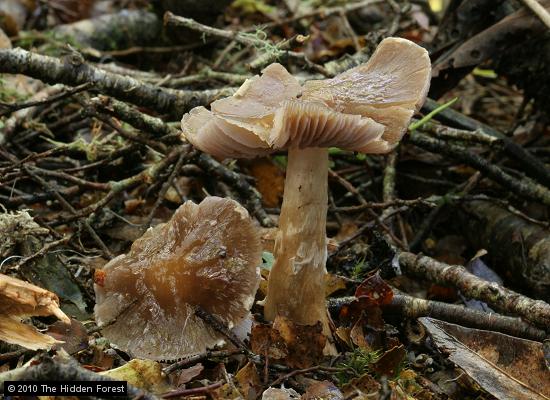
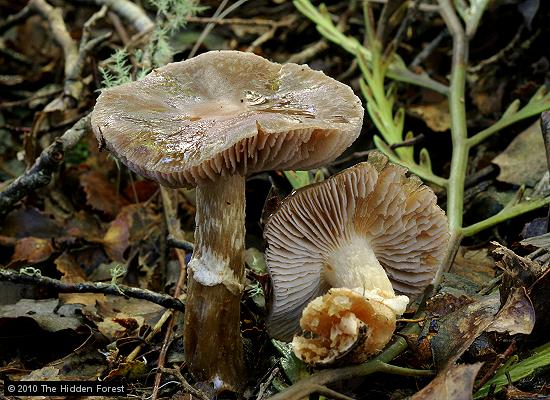
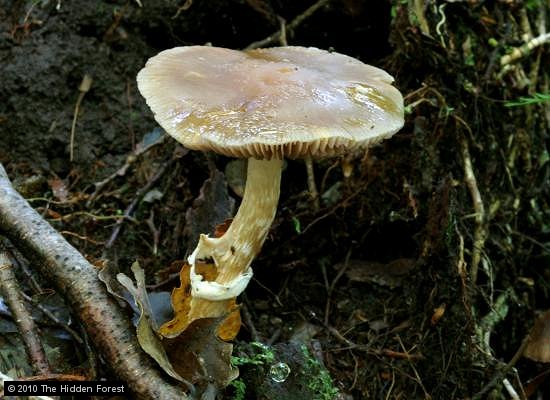
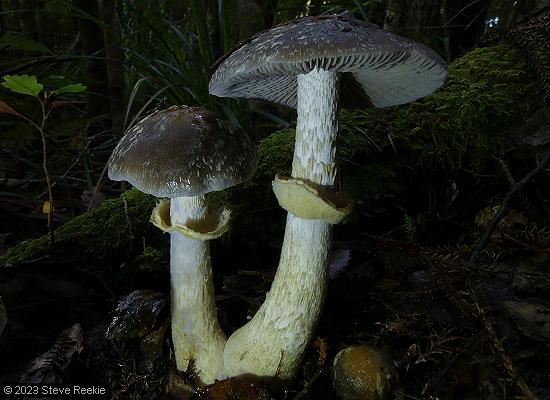
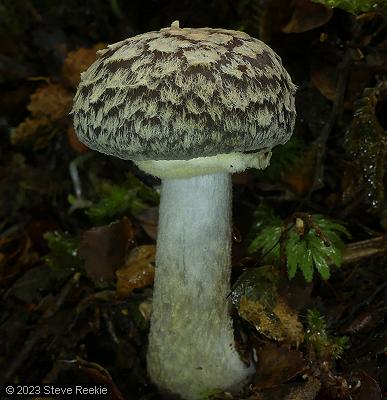
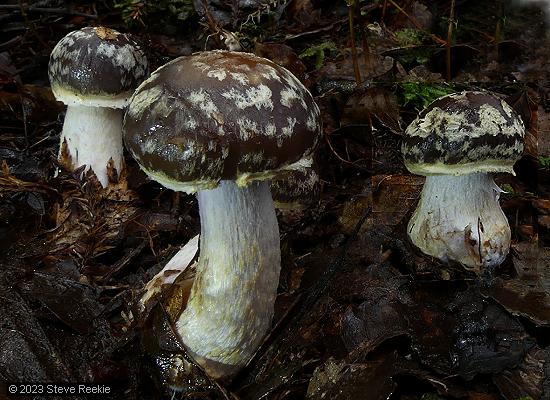
Cap: Up to 85 mm diam.; hemispheric to convex, later expanded or depressed at centre. Colour grey to pale grey‑brown with a lilac tint, becoming ochraceous with age, especially over the disc. Surface densely covered with coarse, persistent, white to pale yellow‑brown fibrillose squamules derived from the veil. Glutinous when moist
Lamellae: Broadly adnate to emarginate, often with subdecurrent teeth; crowded. Colour pale lilac, soon pale argillaceous to pale grey‑brown; edges concolorous, serrate to sinuate.
Stipe: 50-120 x 10-20 mm, cylindrical, equal or subclavate at base. Colour lilac above, pale brown toward base. Surface densely covered with concolorous to ochraceous fibrillose to scaly squamules from the veil; strongly fibrillose. Annulus membranous, striate, pale ochre, persistent though sometimes evanescent. Dry, hollow; solitary or in groups.
Context: Lilac in the upper stipe and beneath the pileus cuticle; pale brown in the stipe base.
Odour/taste: Odour and taste not distinctive.

Common name: None
Habitat: Nothofagus forests
Substrate: On soil.
Distribution: New Zealand wide.
Season: Autumn to early winter
Biostatus: Indigenous
Edible: No
Spore print: Ochre‑brown
Macro images:
Cortinarius meleagris
Scale bar
Scale= 9 mm.
 
Cortinarius meleagris
Scale bar
Scale= 8.5 mm.
 
Cortinarius meleagris
Scale bar
Scale= 8.5 mm.
 
Cortinarius meleagris
Scale bar
Scale= 10 mm.
 As this species ages the white fibers wash of.
Cortinarius meleagris
Scale bar
Scale= 10 mm.
 
Cortinarius meleagris
Scale bar
Scale= 10 mm.
 
The Hidden Forest
Forest Fungi