Gibellula pulchra
(Sacc.) Cavara (1894) (stat. anam.)
Description:
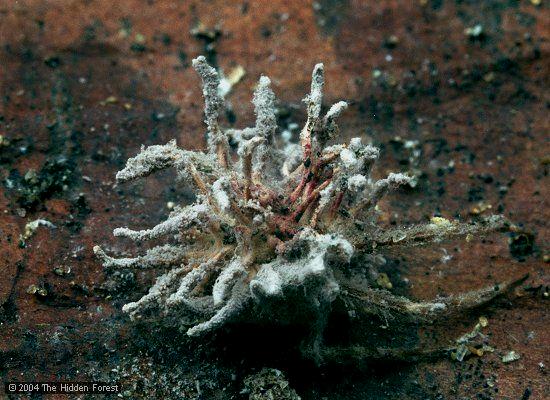
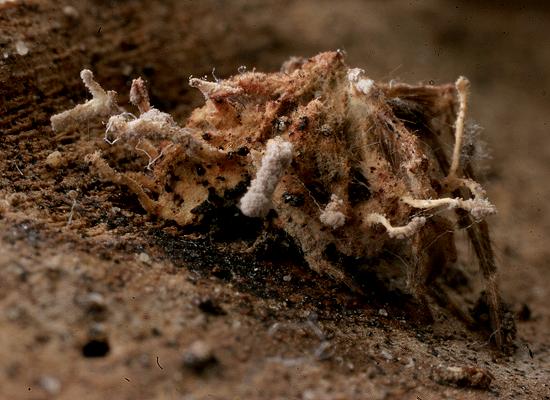
A striking, delicate spider-parasitic fungus producing slender white synnemata topped with powdery conidial heads that range from white to lilac or pale pink. The host spider becomes mummified, often suspended in webbing or lying in leaf litter, with multiple synnemata emerging from the legs, abdomen, or cephalothorax. This is one of the most recognisable species of Gibellula due to its pastel-coloured conidia and elegant branching.

Synnemata (Stalks): 2–15 mm tall, slender, white, smooth Simple or occasionally branched Arise directly from the spider’s body Tips expand into powdery conidial heads
Conidial heads: White, lilac, pinkish, or bluish‑tinted Powdery, dry, easily dispersed Often forming a rounded or slightly clavate head at the tip of each synnema
Host: Spider often bleached or dusted with conidia
Base: Attached directly to the host spider, usually at leg joints or the abdomen.
Colour: Synnemata white Conidial heads white to lilac to pinkish
Size: Synnemata 2–15 mm tall; conidial heads 0.3–1 mm wide.
Growth habit: Multiple synnemata emerging from a single spider; sometimes dozens.

Common name: None
Habitat: Humid forest litter, moss, rotting logs, low vegetation, and spider webs.
Substrate: Parasitic on spiders (Araneae), especially small web‑builders and leaf‑litter species.
Distribution: Cosmopolitan in tropical and temperate forests. Present in New Zealand, though local material may include undescribed species within the Gibellula pulchra complex.
Season: Most frequent in autumn–winter, but can occur year‑round in humid microhabitats.
Biostatus: Present in New Zealand; likely native or naturalised
Macro images:
Gibellula pulchra
Scale bar
Scale= 1.6 mm.
 
Gibellula pulchra
Scale bar
Scale= 1.4 mm.
 
The Hidden Forest
Forest Fungi