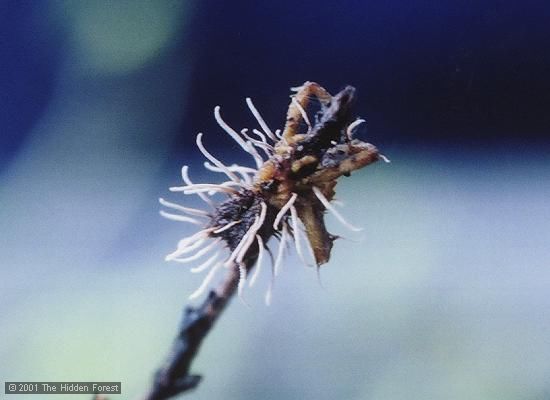
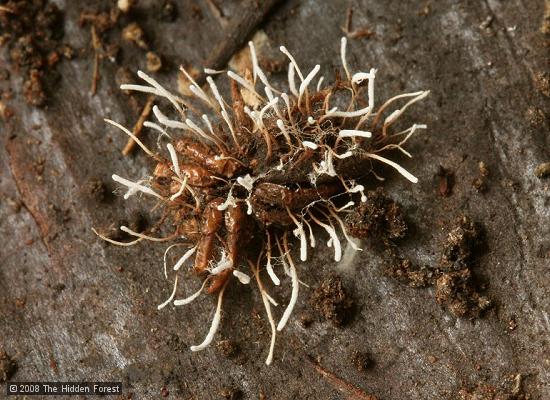
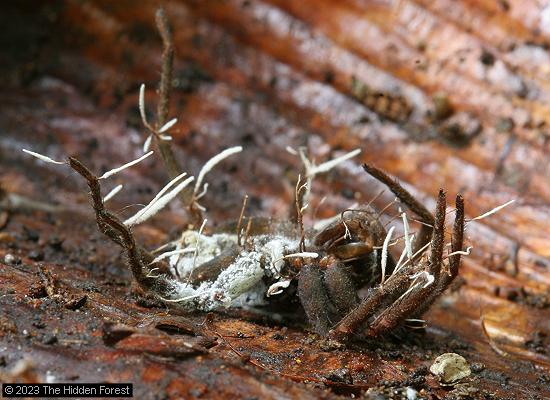
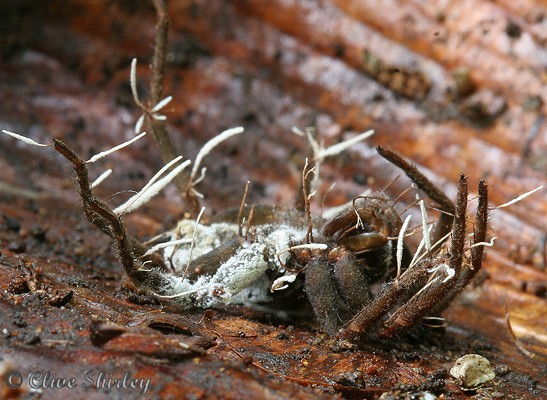
A delicate, pale, spider-parasitic cordycipitoid fungus producing slender, whitish to cream stromata emerging from the body of a dead spider. Stromata may be simple, filiform, or slightly clavate, sometimes arising from multiple points on the host. Perithecia are immersed, visible as tiny pale dots on the stroma surface. Anamorph states are Isaria-like, forming fine white conidiophores.
Stroma: The stroma is 10–40 mm long, slender, cylindrical, smooth, white to cream, sometimes slightly yellowish at the tip. May be solitary or in small tufts.
Base: Stroma arises directly from the host spider’s body, often from the abdomen or leg joints. Host typically lies in leaf litter or attached to vegetation.
Colour: Stroma white, cream, or pale yellowish. Host spider often bleached or mummified.
Size: Stroma 10–40 mm long, 0.5–2 mm thick. Host spider typically 3–10 mm body length.
Growth habit: Solitary or in small groups, each stroma emerging from a single parasitised spider.
Common name: None.
Habitat: Leaf litter, moss, rotting logs, forest floor debris, and humid microhabitats where small spiders occur.
Substrate: Parasitic on spiders (Araneae), including small ground‑dwelling species.
Distribution:
Cosmopolitan in temperate and tropical forests. New Zealand records exist but are poorly documented; material likely includes undescribed species.
Season: Most common in autumn and winter, but may occur year‑round in humid microhabitats.
Biostatus: Present in New Zealand; likely native or naturalised, but taxonomy unresolved.