Singerocybe clitocyboides
(Cooke & Massee) Zhu L. Yang, J. Qin & G.M. Gates 2014
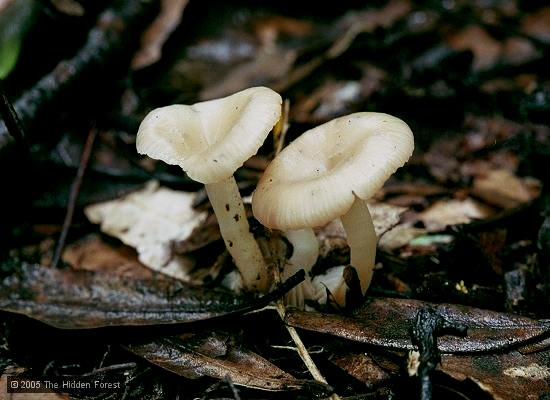
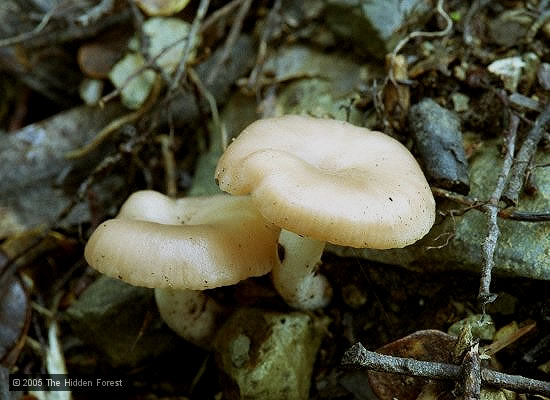
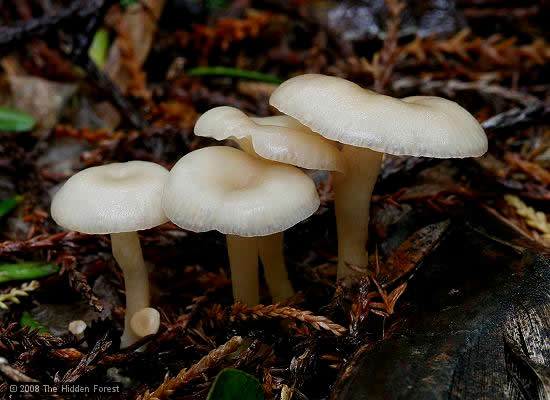
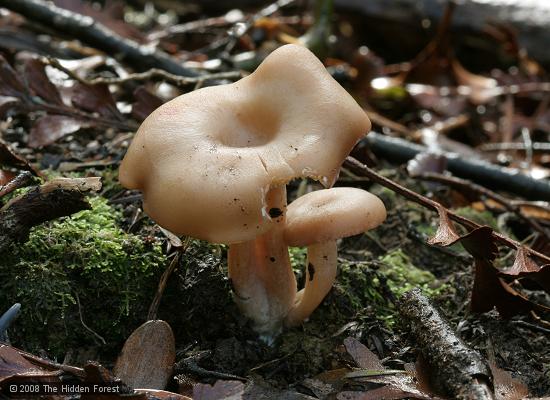
A medium-sized, robust, pale agaric with a smooth cream-buff cap, strongly decurrent gills, and a stout fibrous stipe. Flesh thicker than typical Clitocybe, giving a more substantial appearance. Odour mild to indistinct. A characteristic species of leaf litter in mixed forests, forming a distinct lineage now placed in Singerocybe.
Cap: 40-90 mm, convex becoming plano‑convex, sometimes shallowly depressed. Surface smooth to faintly fibrillose, dry or slightly moist. Colour cream, buff, pale brown, or greyish‑buff, often darker at the centre. Margin even, sometimes slightly wavy in age.
Gills: Crowded, strongly decurrent, pale cream to buff, remaining light throughout development. Edges smooth. Gills run well down the stipe, a key feature separating this species from Lepista and many Clitocybe.
Stipe: 40-80 x 8-15 mm, fibrous, cylindrical or slightly tapered. Surface smooth, cream to pale buff, sometimes darker toward the base. No ring.
Base: Stipe base slightly swollen or rooting, often with adhering leaf litter. No volva.
Colour: Overall cream to buff, sometimes with greyish or pale brown tones. Flesh white.
Size: Cap 40-90 mm; stipe 40-80 mm long.
Growth habit: Solitary, scattered, or in small groups in forest litter.
Common name: None.
Habitat: Mixed broadleaf–conifer forest, forest edges, and well‑developed leaf litter layers.
Substrate: Leaf litter, humus, and forest duff.
Distribution:
Primarily Northern Hemisphere (Europe, North America). New Zealand records are uncertain and may represent misapplied Clitocybe names or undescribed taxa.
Season: Autumn to early winter.
Biostatus: Uncertain / possibly exotic in New Zealand.
Edible:Unknown; not recommended.
Spore print:
White.
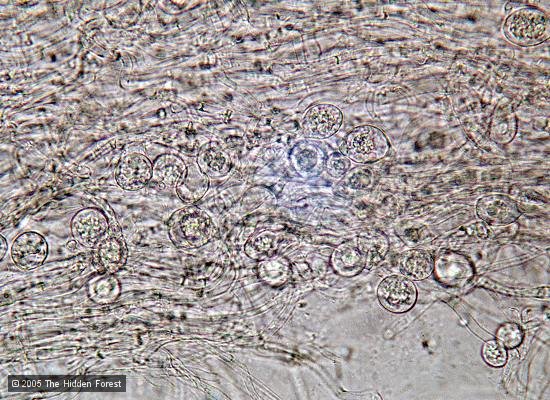
Detail of the cap structure showing these strange round cell structures.