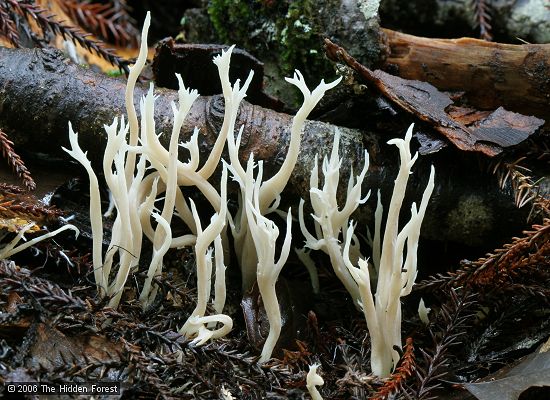
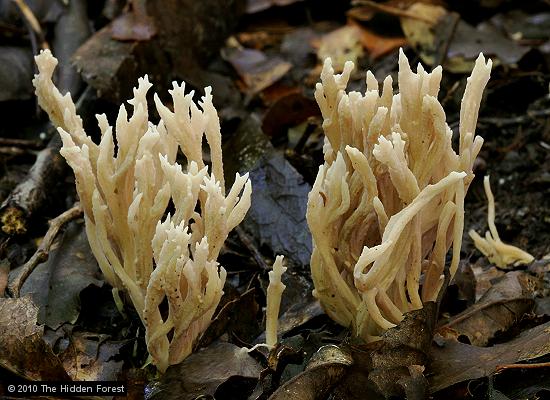
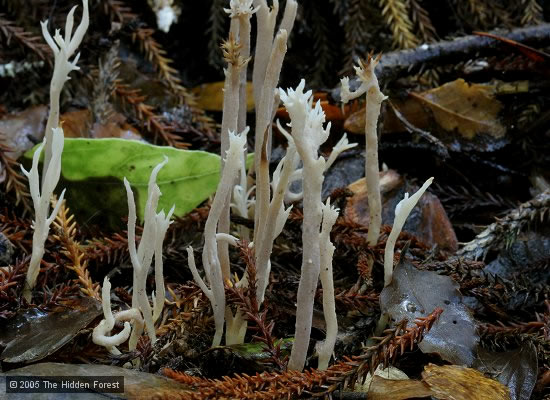
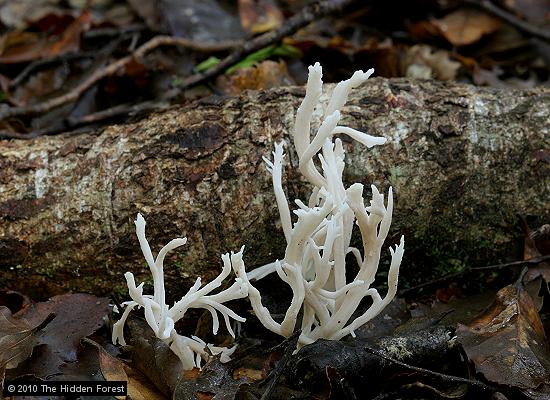
Fruitbodies: Coralloid, 30-80 mm tall, moderately branched, arising from a distinctly hollow stipe‑like base. Branches flattened to subcylindrical, pale grey‑buff to cream‑grey, sometimes with faint lilac or smoky tones. Texture brittle, easily snapped.
Apex: Rounded or irregularly forked; tips usually paler than the branches.
Colour: Pale grey, grey‑buff, cream‑grey, sometimes with faint lilac or smoky hues; drying paler.
Surface: Smooth to faintly wrinkled; older branches may show shallow folds.
Base: Distinctive hollow, tubular base (the key diagnostic feature). Whitish to pale grey; often slightly thickened.
Size: Clusters 30-80 mm tall and 20-50 mm wide.
Growth habit:
Solitary or in small scattered groups; occasionally forming loose clusters.
Common name: None.
Habitat: Moist, shaded forest; among leaf litter, humus, or moss.
Substrate: Soil or humus; rarely on well‑rotted wood.
Distribution: Reported from Europe, North America, Australia, and New Zealand. NZ material is sparse and may include similar grey Clavulina taxa.
Season: Autumn.
Biostatus: Indigenous (likely native but poorly documented).
Edible: Unknown; not recommended.
Spore print: White.