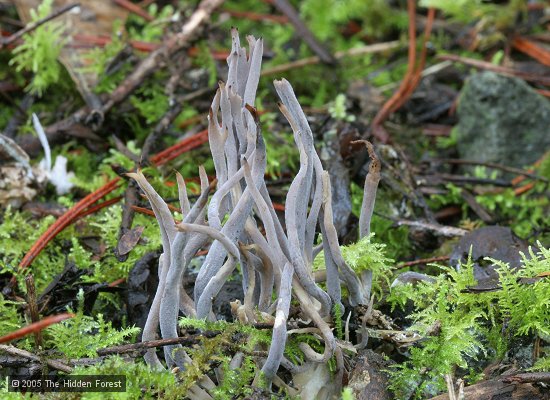
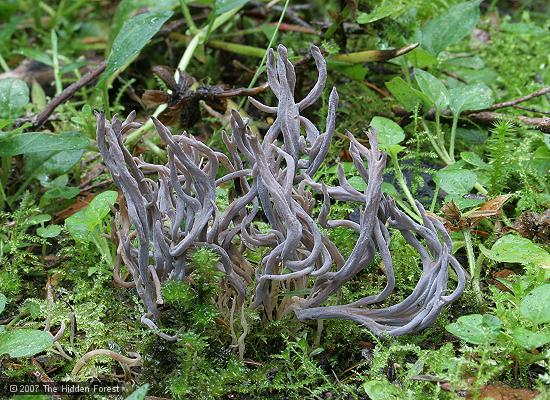
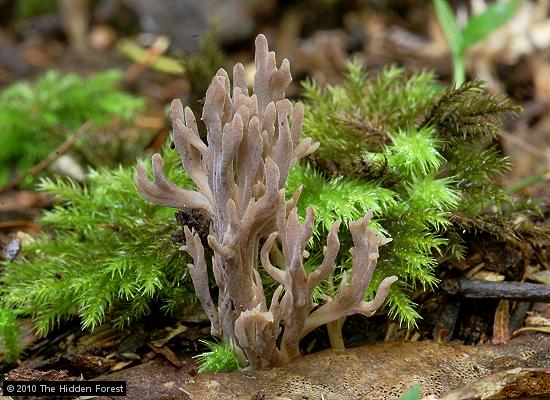
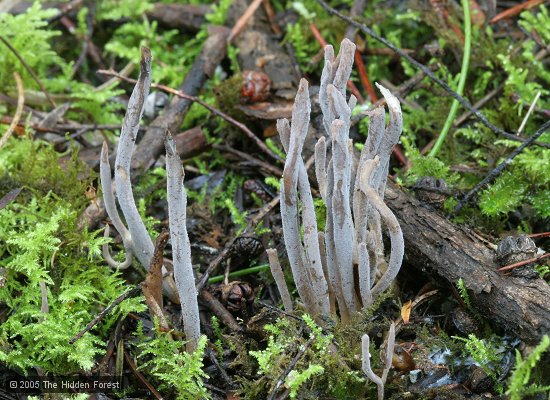
Fruitbodies: Coralloid to club‑branched, 20–70 mm tall, usually with few, thick, upright branches arising from a short base. Branches subcylindrical to slightly flattened, often dark grey‑brown to soot‑grey, giving a superficial resemblance to earth‑tongues. Texture brittle, snapping cleanly.
Apex: Rounded, blunt, or irregularly forked; tips usually paler grey than the main branches.
Colour: Dark grey, grey‑brown, soot‑grey, or mouse‑grey; sometimes nearly blackish when moist. Drying paler grey‑buff.
Surface: Smooth to faintly wrinkled; older branches may show shallow longitudinal folds.
Base: Short, compact, whitish to pale grey; not distinctly stalked.
Size: Clusters 20–70 mm tall and 10–40 mm wide.
Growth habit:
Solitary or in small scattered groups; often forming loose tufts rather than dense corals.
Common name: None.
Habitat: Moist, shaded forest; among leaf litter, humus, or moss, often in mixed broadleaf–podocarp forest.
Substrate: Soil or humus; occasionally on well‑rotted wood.
Distribution: Reported from North America and Australasia; New Zealand material is poorly documented and may represent similar grey Clavulina taxa.
Season: Autumn.
Biostatus: Uncertain in New Zealand (possibly exotic or misapplied; local grey forms may represent undescribed species).
Edible: Unknown; not recomended.
Spore print: White.