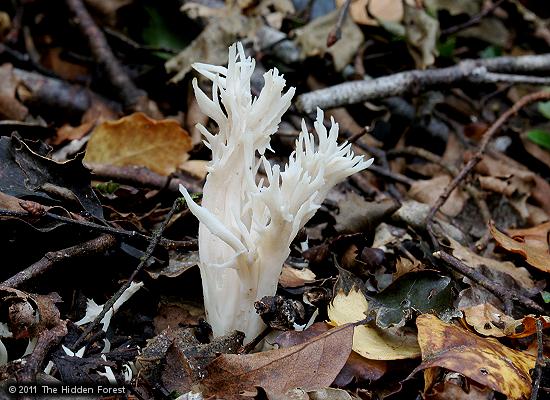
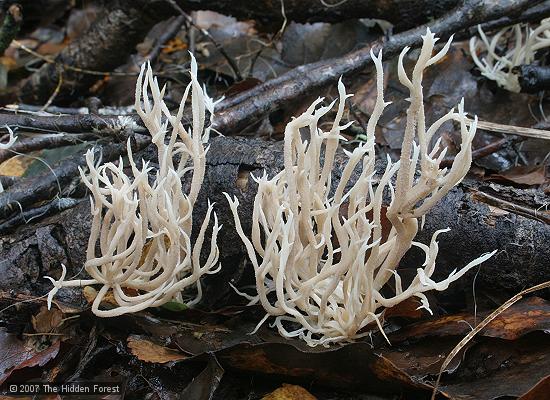
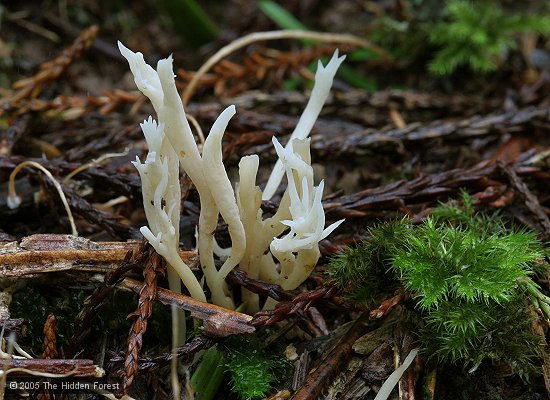
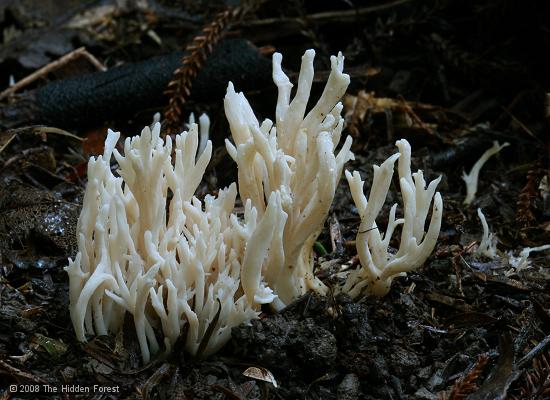
Fruitbodies: Simple to sparsely branched, 20-70 mm tall, arising singly or in small groups. Clubs subcylindrical to slightly flattened, often irregularly shaped, with a partly wrinkled or sub‑rugose surface-less strongly wrinkled than Clavulina rugosa but more irregular than smooth species. Colour white, cream, or pale buff, sometimes with faint greyish tones. Texture brittle, snapping cleanly.
Apex: Rounded or blunt; occasionally with a single fork but rarely more branched.
Colour: White, cream, pale buff, or grey‑cream; drying paler or slightly yellowish.
Surface: Sub‑rugose, with shallow folds or irregular wrinkling, especially on the lower half of the club. Upper portions smoother but still uneven.
Base: Short, compact, whitish; not distinctly stalked.
Size: Clubs 20-70 mm tall and 5-12 mm thick; clusters 10–40 mm wide.
Growth habit:
Solitary or in small scattered groups; rarely forming dense clusters.
Common name: None.
Habitat: Moist, shaded forest; among leaf litter, humus, or moss, often in mixed broadleaf–podocarp forest.
Substrate: Soil or humus; occasionally on well‑rotted wood.
Distribution: Described from North America. Reports from Australia and New Zealand exist but are uncertain, and local material may represent similar pale, irregularly wrinkled Clavulina species rather than true C. subrugosa.
Season: Autumn.
Biostatus: Uncertain in New Zealand (likely misapplied; local material may represent undescribed taxa).
Edible: Unknown; not recomended.
Spore print: White.