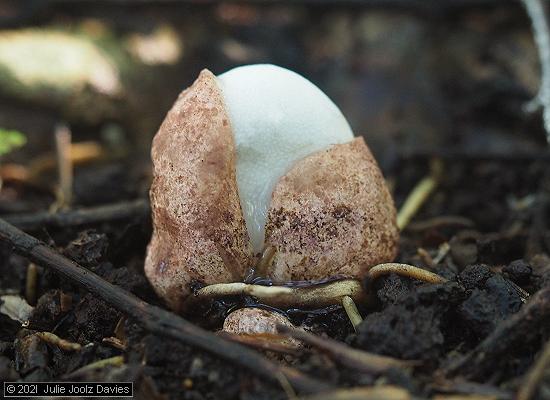
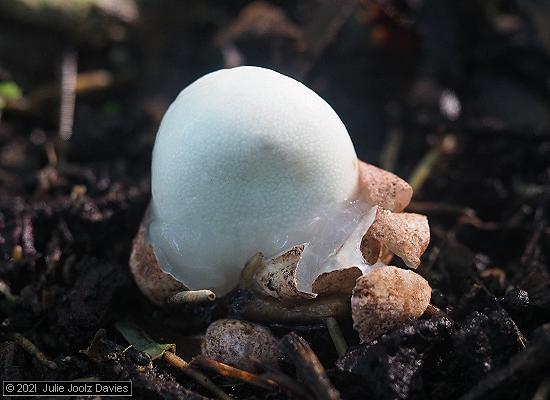
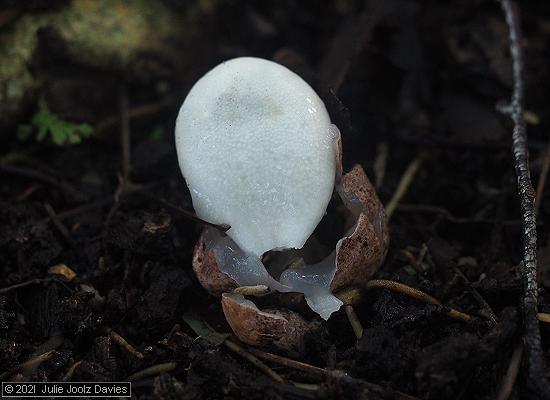
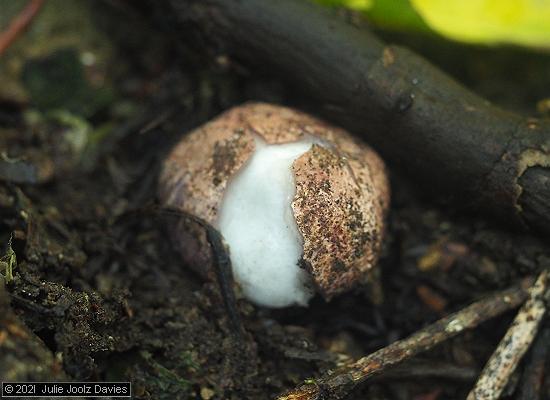
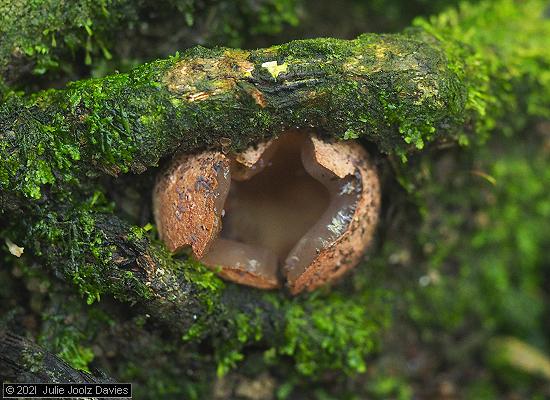
Claustula fischeri
K.M. Curtis (1926)
Description:
A distinctive globose, white, thick-walled gasteroid fungus. Fruitbody partially buried in litter, smooth and whitish when young, becoming cream to pale brown with age. At maturity the peridium splits irregularly, exposing a brown, chambered gleba. Rare and easily overlooked. Looking very much like an unopened Clathrus egg, classified as an endangered species.

Fruitbody: 20-50 mm diameter Globose to subglobose, often partly buried. Peridium thick, white to cream, smooth. Splits at maturity into irregular lobes, revealing the gleba Interior brown, loculate, with irregular chambers.
Gleba: Brown, chambered. Fertile and sterile tissues intermixed. No cap, gills, or stipe - fully gasteroid.
Stipe: Absent.
Flesh: Thick, firm, white; becoming tougher with age.

Common name: None
Habitat: Native forest; often in leaf litter or among mossy soil.
Substrate: On soil or forest litter; saprobic.
Distribution: Known from scattered collections in native forest.
Season: Autumn to winter.
Biostatus: Endemic to New Zealand.
Edible: No, Endangered.
Spore print: White.
Macro images:
Claustula fischeri
Scale bar
Scale= 8.3 mm.
 
Claustula fischeri
Scale bar
Scale= 8.3 mm.
 
Claustula fischeri
Scale bar
Scale= 8 mm.
 
Claustula fischeri
Scale bar
Scale= 8 mm.
 
Claustula fischeri
Scale bar
Scale= 8 mm.
 
The Hidden Forest
Forest Fungi