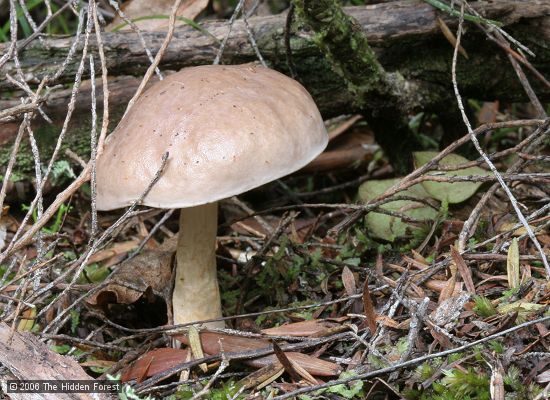
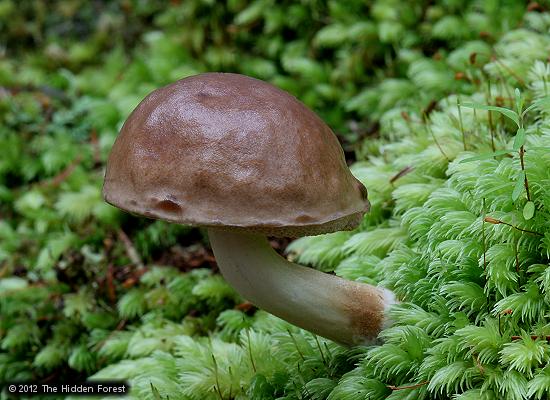
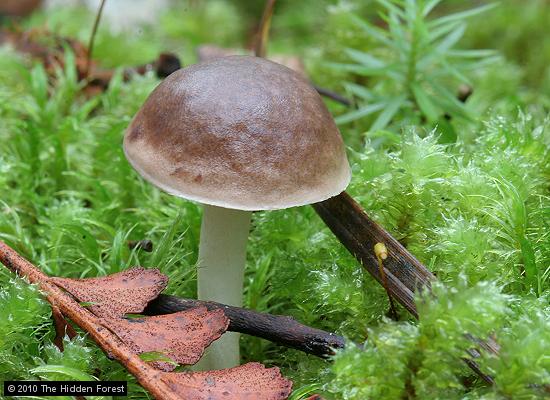
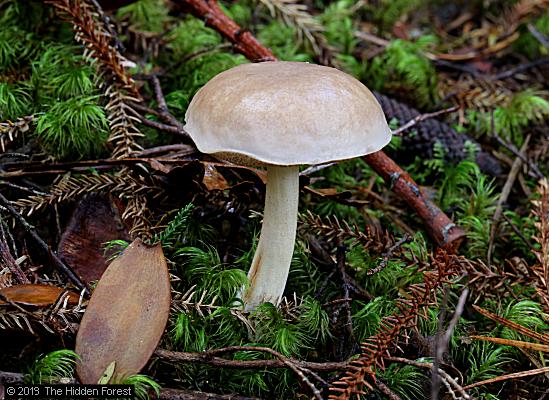
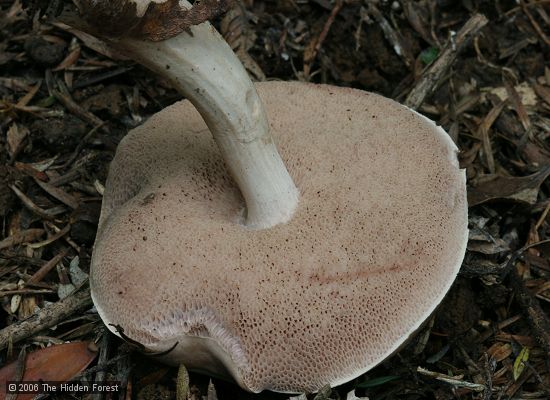
An interesting species in that it has a stick cap when fresh, previously known as Mucilopilus violaceiporus. More recently, this has been renamed to Fistulinella viscida while the similar species found under beech is called Fistulinella violaceiporus. The two can only be told apart by their habitat.
Cap: 20-60 mm, convex to plano-convex, sometimes slightly depressed in age.
Surface distinctly viscid or slimy when moist, becoming tacky or shiny when drying.
Colour whitish, cream, pale buff, or light tan; often slightly darker at the centre.
Margin even, sometimes slightly translucent-striate when wet.
Pores & Tubes: Pores small, round, white to cream to pale pinkish-buff with age.
Tube layer short, concolorous with pores.
No blueing or reddening when bruised.
Pore surface remains pale throughout development.
Stipe: 30-70 mm x 5-12 mm, slender, smooth, dry.
Colour white to cream, sometimes with faint pinkish or buff tones.
No reticulation.
Base may be slightly swollen; basal mycelium white.
Flesh: Soft, white, sometimes with a faint pinkish tint in the cap.
No colour change when cut or bruised.
Odour and taste mild.
Common name: None.
Habitat: Myrtaceae forest.
Substrate: Ground, Ectomycorrhizal.
Distribution: New Zealand.
Season: Autumn.
Biostatus: Endemic.
Edible: No.
Spore print: Light brown.