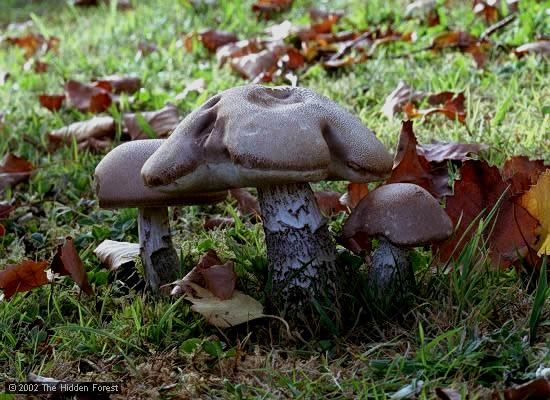
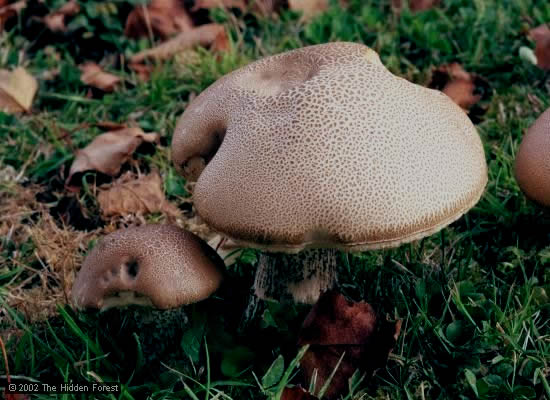
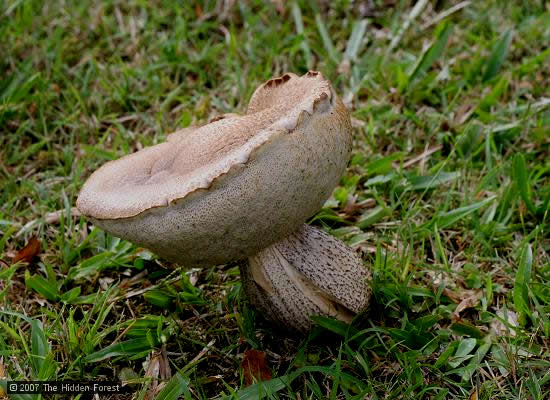
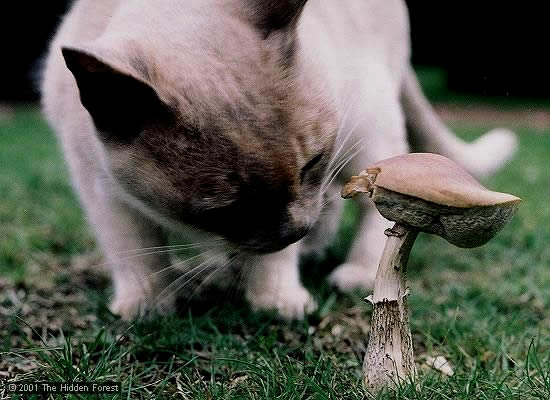
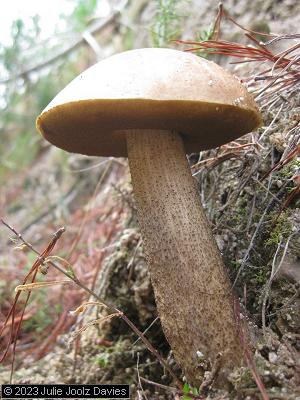
Leccinum scabrum (commonly known as the birch bolete) is a common, edible mushroom. It is easily recognized by its brown cap, pore surface (instead of gills), and a sturdy whitish stem covered in distinctive dark, scaly flecks.
Cap: 50–150 mm, hemispherical to convex to broadly convex.
Surface dry, smooth to finely velvety, sometimes slightly cracked in age.
Colour grey-brown, tan, mouse-brown, or dark brown; typically dull and even-toned.
Margin even, sometimes slightly inrolled when young.
Pores & Tubes: Pores small, round, white to greyish to pale brownish with age.
Tubes white to greyish, not bruising blue.
Pore surface may darken slightly when handled but never stains blue.
Stipe: 80-180 mm x10-30 mm, slender, cylindrical, often slightly swollen at the base.
Surface pale grey-white with abundant dark brown to blackish scabers — the key diagnostic feature.
No reticulation.
Scabers may darken with age or handling.
Flesh: White, firm.
Slowly stains greyish, pinkish-grey, or blackish when cut, variable but typical for the species.
Odour and taste mild.
Common name: Birch bolete.
Habitat: Under silver birch.
Substrate: Soil under birch; ectomycorrhizal.
Distribution: Only where birch has been planted.
Season: Autumn.
Biostatus: Exotic (Introduced).
Edible: Yes.
Spore print: Light brown.