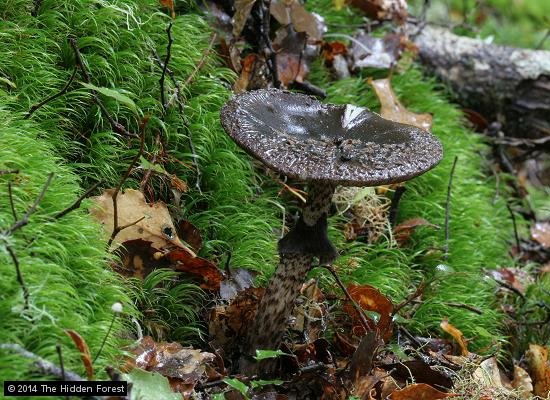
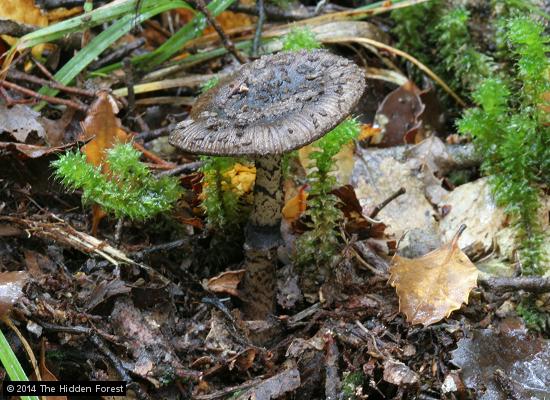
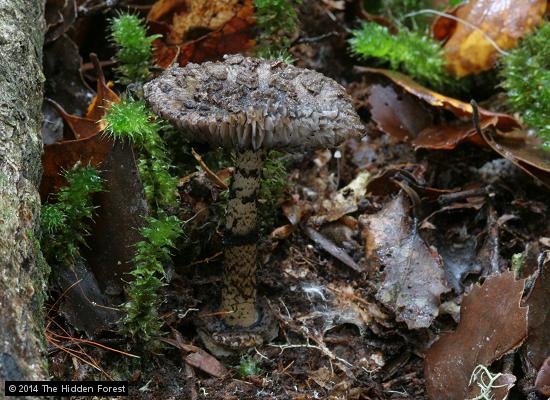
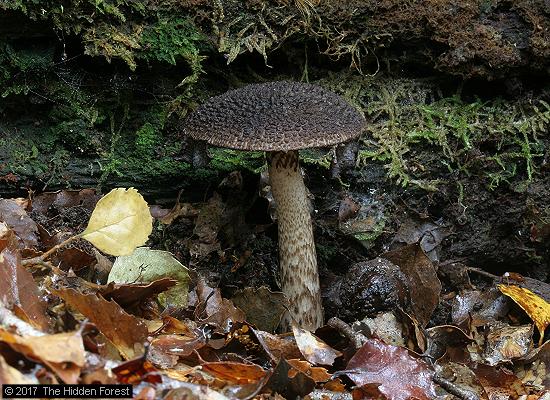
It has some similarities with A. pekeoides. This is smaller and has a ring on the stipe and is covered in veil fragments on the cap.
Cap: Up to 30 mm diameter in the type description, moist, waxy, dark brown, with dark‑brown warts scattered across the surface. Margin striate. Flesh pale grey, but dark brown immediately beneath the cuticle.
Gills: White, free, moderately crowded, with both long and short gills interspersed.
Gill edges have conspicuous blackish‑brown margins, a distinctive feature.
Stipe: Slender (approx. 7 mm thick), tapering upward, white with greyish‑brown fibrillose striations that crack into blackish‑brown scales above and below the ring . Interior slightly hollow above, becoming hollow and chambered toward the base.
Ring: Blackish‑brown, membranous, located on the upper stipe; scales above and below the ring share the same dark pigmentation.
Volva: White with ochraceous tints, but with a blackish‑brown margin that is adpressed to the stipe base, a key diagnostic character .
Flesh: Pale grey, darkening beneath the cap cuticle. No distinctive odour reported.
Common name: Blackening Amanita
Habitat: Nothofagus and occasionally Myrtaceae forests
Substrate: Ground
Distribution: New Zealand wide.
Biostatus: Endemic
Season: Autumn
Height: 100 mm
Width: 30 mm
Edible: Poisonous
Spore print: White