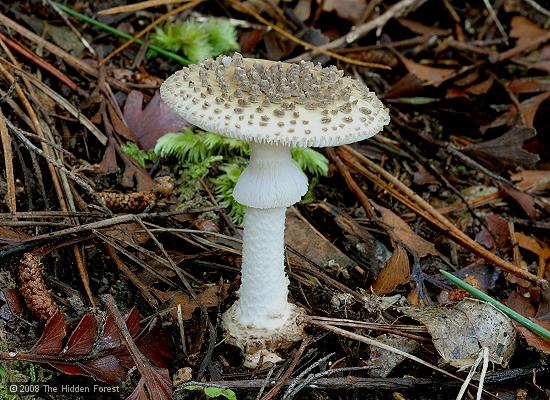
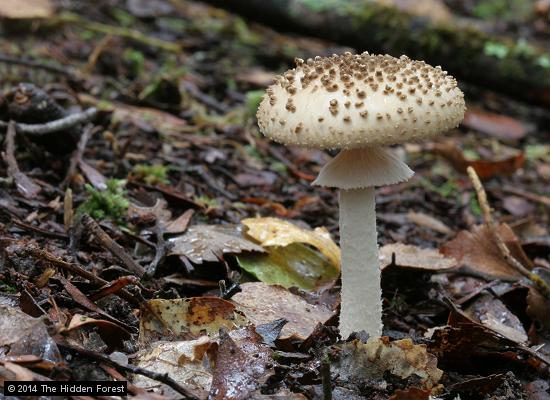
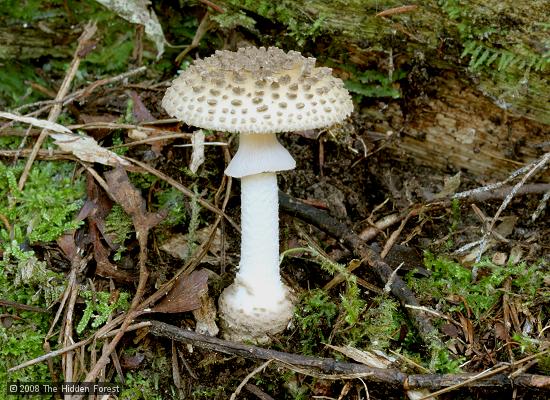
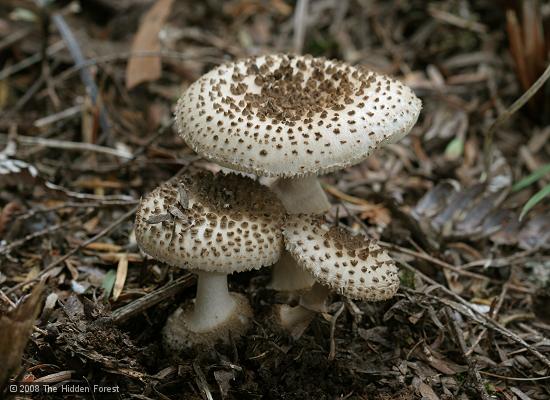
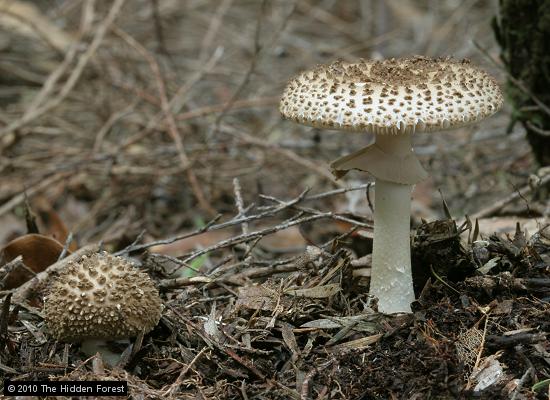
Amanita australis
G. Stev. 1962
Description:
PDD 81233, PDD 82991
This species can be mistaken as either A. australis or A. nothofagi. A close look at the cap will show the dark-brown veil fragments are raised and arranged in a symmetrical pattern on a light-brown background.

Cap: 20–90 mm wide, convex, becoming plane or shallowly depressed. The center is dark buff, honey, or isabelline, paling to buff at the margin. The surface is viscid when young or wet, drying with age. Universa-veil remnants form conical to pyramidal warts, densest at the disc and sparser toward the margin; initially white, later greyish-sepia or isabelline with pale tips. Margin may split and roll back, giving a ragged appearance.
Gills: White, free, crowded, 6–10 mm wide. Short gills are truncated. Margin entire.
Stipe: 37–90 mm tall, 6–26 mm thick, hollow, and narrowest at the center. Base sub-bulbous to abruptly bulbous (14–38 mm). Above the ring: white and floccose; below the ring: white with buff to greyish transverse striate bands.
Ring: Membranous, striate, white to buff; initially pendulous, later adhering to the stipe.
Volva: Present as powdery, greyish-buff to greyish-sepia volval remnants at the base; may form a rim or be fragmentary. Volval warts on the cap are composed of chains of globose to clavate cells.
Flesh: White, sometimes pale isabelline under the disc. Odour not distinctive.
Common name: Straw Flycap
Habitat: Myrtaceae and Nothofagus forests
Substrate: Ground
Distribution: New Zealand wide
Biostatus: Endemic
Season: Autumn
Height: 100 mm
Width: 60 mm
Edible: Poisonous
Spore print: White
Macro images:
Amanita australis
Scale bar
Scale= 10 mm.
 
Amanita australis
Scale bar
Scale= 10 mm.
 
Amanita australis
Scale bar
Scale= 10 mm.
 
Amanita australis
Scale bar
Scale= 10 mm.
 
Amanita australis
Scale bar
Scale= 10 mm.
 
Hidden Forest
Fores Fungi