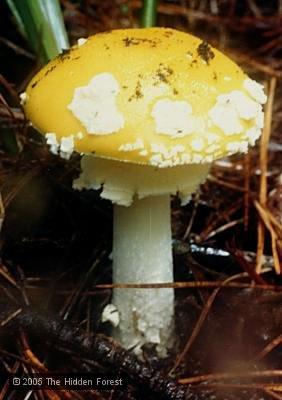
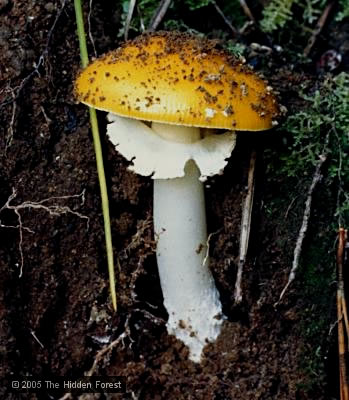
Amanita muscaria (yellow morph)
(L.) Lam. 1783
Description:
This is not a separate species but a stable colour morph within the muscaria complex, These yellow morphs appear especially in wet weather, when red pigments are suppressed or washed out early in development.

Cap: 50-150 mm diameter, bright lemon‑yellow to golden yellow, sometimes fading to pale yellow in age. Surface smooth, viscid when wet, drying to a satin sheen. Universal‑veil remnants appear as white, pyramidal to irregular warts, often numerous and persistent. Margin non‑striate or faintly striate in age. Colour is even, not patchy - unlike washed‑out red forms.
Gills: White, free, crowded. Short gills present.
Stipe: 80-200 mm tall x 10-25 mm thick, white, sometimes with a faint yellowish tint near the apex. Surface smooth to finely fibrillose. Ring large, white, membranous, skirt‑like, persistent.
Volva: Base bulbous, enclosed by concentric rings or patches of white universal‑veil material -a key muscaria trait. Volva never forms a saccate cup.
Flesh: White, firm, unchanging. Odour mild or indistinct.

Common name: Yellow Fly Agaric
Habitat: Ectomycorrhizal with introduced Pinus radiata
Substrate: Ground
Distribution: Widespread but uncommon in New Zealand.
Biostatus: Introduced, naturalised
Season: Autumn
Height: 100 mm
Width: 60 mm
Edible: Poisonous, contains ibotenic acid and muscimol
Spore print: White
Macro images:
Amanita sp.
Scale bar
Scale= 11 mm.
 
Amanita australis
Scale bar
Scale= 11 mm.
 
Hidden Forest
Fores Fungi