Agaricus arvensis
Schaeff.
Description:
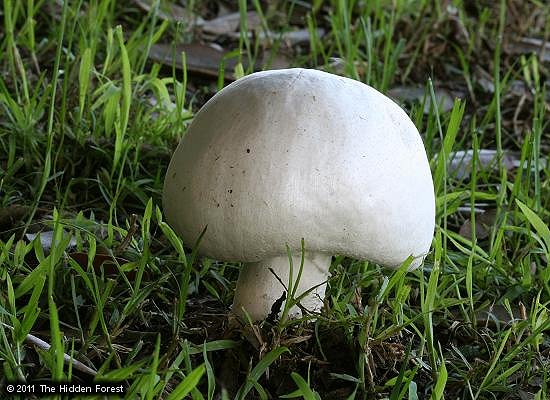
A large, robust Agaricus well sought after for eating, it recognised by its white to cream cap, persistent double ring, anise/almond odour, and slow yellowing of the stipe and cap margin. Widespread in New Zealand pastures, lawns, and parklands, often fruiting in rings.

Cap: 80-200 mm diam.; hemispherical becoming convex to broadly flat; surface smooth to finely fibrillose, white to cream, sometimes faintly yellowing at the margin; may develop pale brownish scales with age.
Gills: free, crowded; pink when young, becoming dark chocolate-brown at maturity.
Stipe: 80-150 x 15-30 mm; stout, cylindrical, sometimes slightly bulbous; white, bruising yellowish when handled; surface smooth to finely fibrillose.
Ring: large, double, thick, and persistent; upper surface smooth, lower surface often with cog-wheel-like scales.
Context: white, firm; slowly yellowing in the stipe base and cap margin when cut.
Odour: strong almond/anise (benzaldehyde), a key character.
Note: There is a similar species, A. crocodilinus, that is claimed to be often mistaken for A. arvensis, a bit of research shows they can be easily told apart.

Common name: Horse Mushroom.
Habitat: Pasturelands and urban greenspaces, forest margins.
Substrate: Saprobic on rich soils.
Distribution: Widespread and common throughout the country.
Season: Autumn.
Biostatus: Introduced; long established.
Edible: Yes.
Spore print: Dark brown.
Macro images:
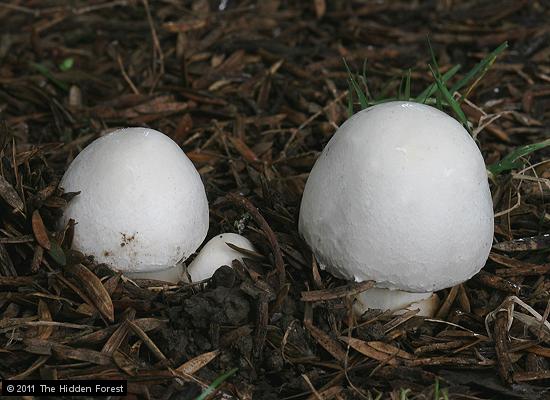
Agaricus arvensis
Scale bar
Scale= 19 mm.
 
Agaricus arvensis
Scale bar
Scale= 17 mm.
 
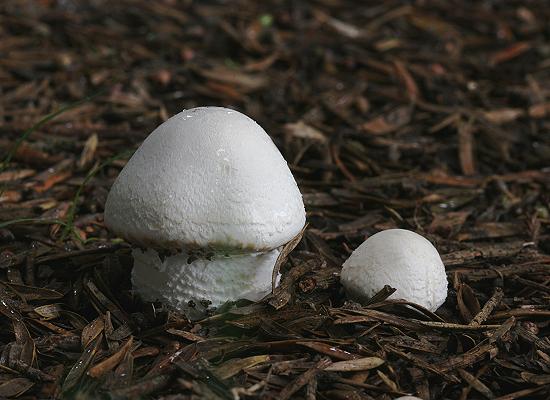
Agaricus arvensis
Scale bar
Scale= 19 mm.
On occasion, I come across what looks like A. arvensis that I find inside the bush line, and I wonder if these are not A. crocodilinus. The short, stumpy size and small scales around the lower stem make me think it could be. Unfortunately, I have not had the chance to see a mature species or to look at these with a microscope.
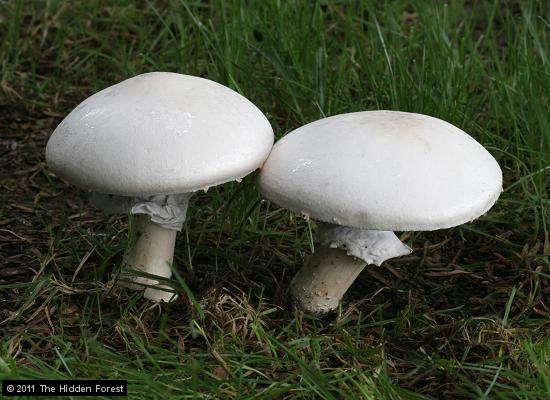
Agaricus arvensis
Scale bar
Scale= 19 mm.
 
Hidden Forest
Forest Fungi