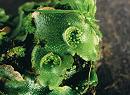
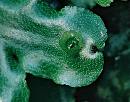
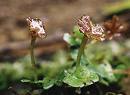
 The sexual reproduction for leafy liverworts is very similar to the mosses. The sexual parts are contained in small and inconspicuous structures known as antheridia (male) and archegonia (female), which develop on separate plant bodies.
In the thallose liverworts, things are a little different. For example in the Marchantia species the antheridia and archegonia are produced on an umbrella like structure. While in others species they are hidden in small pockets on the leafs
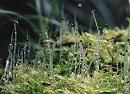
In leafy liverworts the antheridia produce mobile antherozoids (sperm), which require a film of water in which to move to the archegonia, where fertilisation takes place. After fertilisation, a new plant develops, which remains attached to the parent plant. This is the sporophyte.
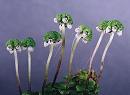 The thallose liverworts have another trick; they harness the power of raindrops to project the sperm up to a metre away from the male plant. Thus placing the sperm on special cup shaped splash areas, which are either on the leaf surface, or in the case of Marchantia species, have an inverted umbrella shaped Antheridiophores. Once the sperm has reached the archegonia fertilisation takes place and the sporophyte grows.
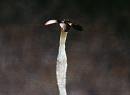 When the sporophyte has matured in the leafy liverworts, the seta that are delicate, white, and glassy, elongate, carrying the capsule some 25 - 50 mm into the air. The capsule contains spores with hygroscopic elaters, which splits open, usually into four segments or valves, and the spores within are released. Under suitable conditions, each spore can germinate and give rise to another gametophyte.
With the thallose liverworts the sporophyte are hidden under the Archegoniophores, or in the case of Marchantia species, in a small structure or pocket on the leaf. The spores are released directly from these structures.